Practical guide
Dog Food Portion Labels: Checking Calories When Package Sizes Change
Separate the package’s net weight, grams in its label cup and calories per gram. Use the exact current food and serving definition to check a recorded portion, or express a known calorie amount in grams, matching cups or whole-container equivalents. Equal calories do not establish diet suitability.
Dog food portion-label converter
Separate package size, cup weight and calorie density
A new bag size does not, by itself, tell you to change the food amount in the bowl. Three things need separate checks: the package's net weight, the amount of food in the stated serving unit, and the calories per gram of that food. A changed recipe or container size can affect more than one of them.
Read the exact current product, variety and size. A calorie value from the old bag or a similarly named online listing may describe a different product. Keep a photo or written copy of the old and new statements for your own comparison.
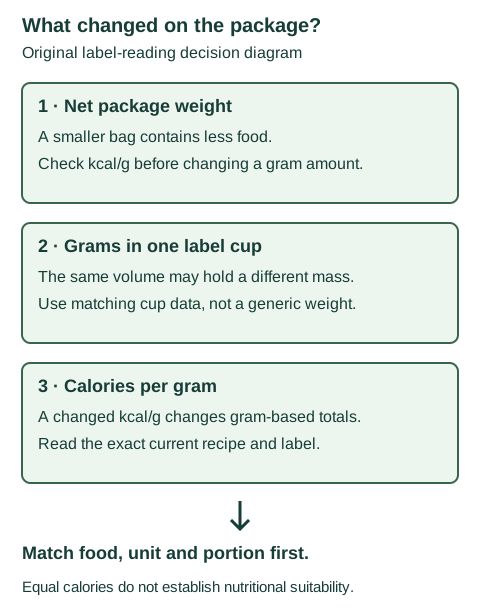
The comparison below is arithmetic, not a decision that a food change is appropriate. If your dog has a veterinarian-directed diet or the feeding question involves health, weight or appetite concerns, bring the exact labels and amounts to your veterinary team.
Copy the calorie number together with its unit
AAFCO’s consumer calorie guidance describes a “Calorie Content” statement in kcal/kg as fed and a familiar unit such as a cup or can. A food calorie is a kilocalorie, abbreviated kcal. Its discussion of a 2014 labeling change is historical; this guide does not turn that timeline into a current deadline or a claim about every market.
| Label field | What it describes | Useful next step | Common misreading |
|---|---|---|---|
| kcal/kg | Calories per 1,000 g of this food as fed. | Divide by 1,000 to get kcal/g. | Not kcal in the whole bag or a cup. |
| kcal per cup | Calories in the product-specific label cup. | Use matching grams per that cup when converting to grams. | Do not substitute a generic grams-per-cup value. |
| kcal per whole container | Calories in the exact whole can, pouch or tray. | Use that size’s net food grams for a gram conversion. | Do not copy calories from a larger or smaller can. |
| Net weight | Food weight in the package, excluding packaging. | Useful with matching weight-based calorie density. | Not calorie density or the weight of one scoop. |
| Guaranteed analysis | Nutrient guarantees, usually minimum/maximum rows. | Read separately for its own label question. | Not a substitute for the calorie statement. |
Use as-fed calories for the food you actually portion, including its water. A dry-matter nutrient percentage is another basis and is not the food’s kcal/g. Keep the calorie statement separate from protein, fat or moisture guarantees.
For a mixed-recipe multipack, use each recipe’s own value and size. Do not assign one can’s calories to every can just because the outer case looks uniform. If the data or serving definition is missing, ask the manufacturer for the exact current product information before calculating.
The formulas for grams, matching cups and whole containers
Start with a weight-based density whenever the current product provides it:
kcal/g = kcal/kg ÷ 1,000
Portion kcal = food grams × kcal/g
Food grams for a known kcal amount = known kcal ÷ kcal/g
For a cup, you need calories per the label cup and the matching weight of food in that same cup definition:
kcal/g = kcal per label cup ÷ grams per matching cup
Label-cup equivalents = known kcal ÷ kcal per label cup
Grams = label-cup equivalents × matching grams per cup
A cup is a volume, not a fixed weight for all kibble. Product size, shape and the stated measuring basis matter. Use matching manufacturer information or clearly identified measurements for the actual food. An inferred grams-per-cup figure from rounded calorie statements is approximate; it is not a scale measurement.
For a whole can, pouch or tray:
kcal/g = kcal per whole container ÷ net food grams in that container
Whole-container equivalents = known kcal ÷ kcal per whole container
Grams = whole-container equivalents × net grams per container
“1.33 containers” is a calculated equivalent, not a precise instruction to eyeball one-third of a can. Weigh a practical portion when that is the measuring method in your agreed feeding plan. The tool rounds displayed results and cannot remove the uncertainty of rounded labels or imprecise measurements.
Four fictional package-change examples
All sizes, cup weights and calorie values in this table are invented to demonstrate unit checking. They are not manufacturer test results, brand comparisons or amounts a dog should eat.
| Change | Matching fictional label facts | Worked arithmetic | Interpretation |
|---|---|---|---|
| Only bag net weight changes | Old 6 kg bag and new 4 kg bag both state 3,600 kcal/kg. | A recorded 100 g portion contains 100 × 3.6 = 360 kcal in either example. | The new bag has fewer total calories, but this gram portion’s label-based calories are unchanged. |
| Cup weight changes at the same kcal/g | Old label cup: 100 g and 360 kcal. New matching cup: 125 g and 450 kcal. Both give 3.6 kcal/g. | Keeping one label cup changes 360 to 450 kcal. Expressing the known 360 kcal in the new example gives 360 ÷ 450 = 0.8 cup; 0.8 × 125 = 100 g. | Same cup count is not the same gram amount. These cup weights are fictional matched data, not a generic conversion. |
| Calorie density changes | Old food: 3,600 kcal/kg. New food: 4,000 kcal/kg. | The same 100 g describes 360 kcal then 400 kcal. Expressing a known 360 kcal in the second food gives 360 ÷ 4 = 90 g. | Equal-calorie arithmetic does not decide whether this food or portion suits the dog. |
| Whole-container size changes | Old can: 400 g and 400 kcal. New exact can: 300 g and 300 kcal. Both give 1 kcal/g. | One whole can changes 400 to 300 kcal. Expressing a known 400 kcal in the new example gives 400 ÷ 300 = 1⅓ containers, or 400 g. | Use the new whole-can value. A fractional container is a calculated equivalent; it is not a recommended daily amount. |
When both recipe and package change, do not assume only one row applies. Check the current calories, serving definition, net weight and adequacy wording separately. A statement such as “same brand” does not settle those fields.
Keep the portion conversion separate from a daily feeding plan
The converter starts with a known amount. It does not calculate a dog’s calorie requirement from weight, age or activity. AAFCO notes that a veterinarian or other appropriate animal professional can help determine individual calorie needs. Use the amount and feeding instructions agreed for your actual dog rather than copying the fictional examples.
If you are checking a daily record, write each food and extra separately. A portion served is not necessarily the amount eaten when food is left over. A treat, topper and complete food can all contribute calories while having different nutritional roles. Do not add another food’s calories to an unchanged meal and assume the total stayed the same.
For example, a fictional record of 180 kcal at breakfast, 180 kcal at dinner and 40 kcal of counted extras totals 400 kcal, not 360. That is an addition example; it does not prescribe a daily allowance or recommend taking a particular amount out of the main meal.
FDA explains that the nutritional adequacy statement identifies a food intended as a complete and balanced diet, with life-stage distinctions. Treats, snacks and supplements are typically not intended as the sole diet. Two portions with equal calories therefore need not provide interchangeable nutrition or suit the same clinical purpose.
Use the adequacy-statement guide for that separate evidence question. Use the cost per 1,000 calories calculator when the question is shopping value; a lower cost is not a feeding instruction or nutrition score.
Six label-and-portion cases to practise
Use these original fictional cases to check the unit and the limits of the arithmetic.
Case 1
The bag shrinks from 6 kg to 4 kg. Both labels state 3,600 kcal/kg. Did the label-based calories in a 100 g portion change?
Show answer and explanation for case 1
No. That portion is 360 kcal in both fictional examples.
The net package weight changes the amount of food in the bag, while the matched calorie density stays 3.6 kcal/g. Multiplying the same 100 g by that density gives the same portion value. Recheck the exact current recipe and statement in a real comparison; package appearance alone does not establish that density is unchanged.
Case 2
A new matching label cup is 125 g and 450 kcal. How does a known 360 kcal amount translate in that food?
Show answer and explanation for case 2
0.8 label cup, equivalent to 100 g using the stated matching data.
Divide 360 by 450 to obtain 0.8 cup equivalent, then multiply by 125 g per that cup to obtain 100 g. The cup weight must describe the same food and serving definition. This is arithmetic from fictional matching data, not a generic kibble conversion or an instruction that any dog should receive 360 kcal.
Case 3
You have kcal per cup and bag net weight, but no matching grams per cup or kcal/kg. Can you derive calories in a weighed gram portion using a standard cup weight?
Show answer and explanation for case 3
No. Obtain the missing matching information.
A cup is a volume unit; the actual food mass in it is not a universal number. Bag net weight describes the whole bag, not one cup. Ask for the current product’s weight-based calories or the matching cup definition and gram information. Leave the result unknown rather than filling the gap from another recipe or a generic internet conversion.
Case 4
The old whole can contains 400 kcal; the new exact can contains 300 kcal. Does retaining one whole can retain the same calories?
Show answer and explanation for case 4
No. The whole-can amount now describes 300 kcal in this example.
Read the calories for the exact new size and recipe. The known 400 kcal corresponds arithmetically to 400 ÷ 300 = 1⅓ new-can equivalents. That fraction is not a recommended daily allowance or permission to replace a prescribed food. Net food weight helps express the calculation in grams when matching data are available.
Case 5
Two foods provide equal calories in the portions you calculated. Does this establish equal nutritional suitability for a growing puppy or a dog on a therapeutic diet?
Show answer and explanation for case 5
No. Calories do not establish diet suitability.
Keep species, life stage, adequacy wording, intended feeding role and the individual veterinary plan separate from the calculation. FDA’s complete-and-balanced explanation concerns a whole-diet claim, not the equality of two calorie numbers. An equal-calorie substitution can still change nutrients or interfere with the purpose of a veterinarian-directed diet.
Case 6
A fictional daily note lists 180 kcal at breakfast, 180 kcal at dinner and 40 kcal of extras. Is the recorded total 360 kcal?
Show answer and explanation for case 6
No. The recorded sum is 400 kcal.
Add the extras to the meal values: 180 + 180 + 40 = 400. This records what the supplied numbers describe; it does not decide the dog’s required allowance or what to remove from the diet. Keep portions, products, amounts eaten and other feeders visible so that the actual feeding question can be discussed with the veterinary team.
Save the old/new label record and ask a specific veterinary question
Download the label comparison, portion record, worked examples and explained cases. Keep the exact product name, size, calorie value, unit and date beside the calculation. Preserve uncertainty rather than silently assigning a missing cup weight.
A useful veterinary question is: “This is the old and new product label, and this is the amount actually served. Which food, amount and monitoring plan should I use for my dog?” Include other foods and extras, the current plan and the reason for the question. If appetite, health or weight changes are involved, make those concerns explicit; the converter does not evaluate them.
For missing label data, ask the manufacturer: “What is the current as-fed kcal/kg for this exact recipe and package, and what cup or whole-container definition matches the familiar-unit calories?” Save the actual response and its date. A similarly named food or an old label is not a substitute.
Read the wet and dry food comparison for storage, practicality and format questions. Use the separate dry-matter worksheet for nutrient moisture-basis questions. A calorie conversion answers neither of those tasks.
Sources and further reading
- AAFCO: CaloriesCalorie Content, kcal/kg as-fed and familiar-unit wording, food-calorie terminology, individual calorie-needs context and limits of calorie-only decisions. Historical compliance dates are not current deadlines.
- FDA: Complete and Balanced Pet FoodNutritional adequacy, species/life-stage context and the distinct role of treats, snacks and supplements. No single calorie number is treated as proof of suitability.