Pet Food Safety: Storage, Handling and Product Concerns
Start with the situation: storing a bag, handling leftovers, washing bowls, checking a recall or responding to a suspected food problem. Use the task links below; seek veterinary help promptly when your pet is ill or an exposure may be urgent.
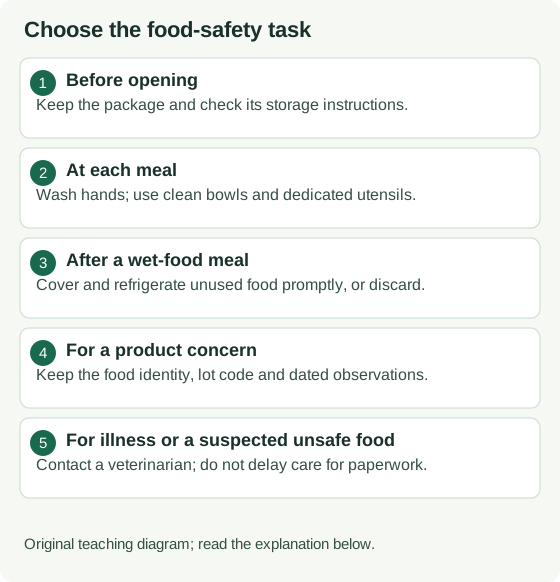
Start with what happened
A safety question usually begins with a concrete event: a bag needs a storage container, a wet-food portion is left over, the power has gone off, a product is named in a recall, or a pet may have eaten something unsuitable. Those events need different next steps. A calorie calculation cannot tell you whether food was stored safely, whether a lot is recalled, or whether an animal needs care.
If your pet is ill and you suspect a pet-food problem, FDA advises stopping that food and calling your veterinarian. This means the suspected product; it is not an instruction to withhold all food from every animal. If there is a suspected toxic exposure or a swallowing emergency, seek veterinary help promptly. Do not work through this directory or collect a complete worksheet before getting help.
| Situation | First useful task | Information to keep |
|---|---|---|
| Normal food storage | Read the package’s storage instructions. | Product identity, whether opened, and storage location. |
| Unused wet food | Refrigerate promptly or discard; use the product’s directions. | Whether untouched or served, opening time and storage conditions. |
| Recall or product concern | Match the food and identifying codes; contact the appropriate professional when needed. | Product name, UPC/barcode, lot, date wording and observations. |
| Illness or suspected unsafe exposure | Contact a veterinarian promptly. | Animal, suspected food or object, amount if known, time and symptoms. |
Storage and leftovers
FDA recommends keeping dry pet food in its original bag. If you use a second container, placing the whole bag inside it helps retain the manufacturer’s identity, UPC, lot number and best-by date. If you pour food directly into a container, save that identifying information and use a clean, dry container with a lid. Wash and dry a reusable container between bags rather than topping up old residue indefinitely.
For dry food and unopened canned food, FDA’s storage advice is a cool, dry place below 80°F. Unused or leftover canned and pouched food should be refrigerated promptly or thrown away. Cover refrigerated pet food tightly and keep the refrigerator at 40°F or below. A shelf-stable unopened can, an opened can and a product sold refrigerated are different situations: check the actual product’s requirements.
These temperatures do not establish a universal number of safe days after opening, or a guaranteed safe duration in a cooler. A cold-looking pack, a sealed lid or a food’s appearance cannot supply a missing temperature history. Keep uncertain conditions marked uncertain and follow product-specific guidance.
Pet Food Storage at Home
Choose a suitable place and retain the original product information.
Pet Food Bag Storage Mistakes
Check what changes when a bag is tipped into another container.
Leftover Wet Food Storage
Separate untouched food from bowl leftovers and check the product’s instructions.
Dry Food Mold and Rancidity Checks
Record a change in the food; appearance alone cannot establish safety.
Safe Treat Storage for Dogs and Cats
Read the actual treat’s storage directions instead of assuming every treat stores alike.
Summer Heat Pet Food Safety
Check heat exposure and the required storage conditions for the particular food.
Power Outage Pet Food Safety
Keep temperature and product requirements visible when normal refrigeration is interrupted.
Hands, bowls and measuring utensils
FDA recommends washing your hands with soap and hot water for at least 20 seconds before and after handling pet food and treats. Wash pet-food bowls and utensils after each use. Wash water bowls daily. Use a dedicated scoop or spoon rather than using the animal’s feeding bowl as the scoop.
Build washing into the meal routine instead of treating it as an optional job at the end of the week. Away from home, plan where soap, water, a clean bowl and a drying area will come from. Label a food scoop if several people handle meals; a shared bowl or utensil can also make it harder to tell which food was served to which animal.
How to Clean Pet Food Bowls
Plan cleaning around each use, including what is needed away from home.
Cleaning Measuring Cups and Scoops
Use a dedicated, clean measuring utensil rather than scooping with the feeding bowl.
Safe Water Bowl Routine
Include daily water-bowl washing in the household routine.
Raw Pet Food Handling Safety
Review the handling task for raw food; storage, handwashing and preparation all matter.
Food Sharing in Multi Pet Homes
Record which animal can reach each bowl and which food each is intended to receive.
Recalls and product concerns
A recall check needs the exact food and the identifiers named in the notice. Keep a clear photo of the front of the package, the UPC or barcode, the lot code and the printed date with its surrounding wording. A broad brand match or a similar package colour does not by itself show that your bag is the affected product.
For a suspected food problem, write observations separately from conclusions. “Opened this bag on Monday; vomiting started Tuesday” is a chronology, not proof that the food caused illness. Save enough information to identify the food and explain the event. Ask the veterinarian or relevant reporting authority what further information is useful for your actual case.
How to Check Pet Food Recalls
Match an actual product and identifying codes to the notice you are checking.
How to Read Lot Codes During a Recall
Keep the production identifier separate from a best-before or other date label.
How to Report a Pet Food Concern
Prepare the product identity and observations relevant to a specific concern.
Human foods, chews and household access
These links address different household situations. Choose the topic for the animal involved and the type of exposure. Routine questions about table scraps or holiday access are different from a suspected poisoning or an animal struggling to swallow. When help is urgent, contact a veterinary professional before reading a long list.
For routine prevention, agree who may give extras, where human food is left, and how visits or celebrations change access. Keep uncertain quantities visible in a record. An unknown snack is not the same as no snack; recording it does not make that food safe or nutritionally suitable.
Foods Dogs Should Never Eat
Review accidental access to human foods for a dog.
Foods Cats Should Never Eat
Use the cat-specific topic when the animal involved is a cat.
Human Foods Dogs Should Usually Avoid
Consider routine human-food sharing separately from an urgent suspected exposure.
Human Foods Cats Should Usually Avoid
Keep a cat’s regular diet and household extras identifiable.
Table Scraps and Routine Boundaries
Agree who gives extras, what was given and how it is recorded.
Holiday Foods Pet Owners Should Watch
Plan access to food during visits, celebrations and disrupted routines.
Choking Risk at Mealtime
Choose the swallowing-safety topic when food or objects are the concern.
Bone Chews and Feeding Safety Questions
Keep questions about bones and chews distinct from calorie arithmetic.
Packing for a change of location
Moving a meal changes the storage and cleaning arrangements even when the food and daily amount stay the same. Keep measured portions identifiable, retain the label or a clear copy, and specify who feeds which animal. Reserve stock is something carried for a delay, not an instruction to feed an extra portion.
For wet food, distinguish shelf-stable unopened packaging from opened food and from food that requires refrigeration before opening. Plan the required cold storage and handling. A container that prevents leaks does not by itself prove adequate temperature control.
Travel-Day Pet Food Packing: Portions, Storage and Handover
Pack measured stock, retain food identification and plan wet-food storage and washing.
Save a usable record
Download the plain-text record, or copy the fields below. Keep unknown facts marked unknown.
PET FOOD SAFETY TASK RECORD
This is a household record, not a diagnosis or a safety certificate.
For illness or an urgent suspected exposure, seek veterinary help promptly.

Animal and species:
Task: ordinary storage / leftovers / recall check / product concern / other:
Exact food or treat name and package size:
Original package retained, or clear label photos available:
UPC/barcode:
Lot code:
Printed date and the words around it:
Opened? If yes, when:
Actual product storage instructions:
Where and how it was stored:
For wet food: untouched portion or food already served:
Known temperature information; mark unknown conditions:
Cleaning arrangements for bowls and dedicated utensils:
Observation and time (describe facts without assuming a cause):
For a veterinary call: symptoms, suspected exposure and amount if known:
Next task or professional instruction:
Check your understanding
Does a calorie label tell me whether a bag was stored safely?
No. The calorie label describes food energy. Storage instructions, conditions, opening status and product identity answer different questions.
Must I finish the product record before calling about an ill pet?
No. Seek veterinary help promptly. Bring or collect the useful identifiers when doing so does not delay care.
Does a tightly closed wet-food container remove the need for refrigeration?
No. A lid helps cover food; it does not establish the temperature required for unused opened wet food.
Should I throw away the original bag after filling a storage bin?
Keeping the original bag, ideally inside the secondary container, retains product and lot information. If food is transferred directly, save the identifying information and use a clean, dry, lidded container.
Sources and scope
These sources explain US dog and cat labels and pet-food handling. The examples, diagrams and worksheets are teaching material rather than measurements of real products. Follow the actual product’s instructions and your veterinary plan where one applies.