Practical guide
Traveling with Wet Pet Food: Storage and Packing Checklist
Keep the actual food and its storage instructions connected through departure, meals and arrival. Plan what happens after opening, check cold-storage arrangements and leave a useful handover. An original meal map, packing sheet and six worked cases help you avoid guessing cooler hours or borrowing another product’s timing rule.
Plan the storage chain before packing
Wet food can be convenient on a journey when you know what happens before opening, after opening and after a meal. Plan those stages before putting a can in a bag. FDA says unused or leftover canned and pouched pet food should be promptly refrigerated or discarded. An opened can waiting in a parked car is not a storage plan.
This guide covers commercially packaged wet dog or cat food, mainly shelf-stable cans and pouches. Food sold refrigerated or frozen needs its own instructions; “unopened” does not make it shelf-stable. Raw-food handling and thawing need separate guidance. Keep a veterinarian-directed diet and its feeding instructions in place rather than substituting a travel-friendly product yourself.
Choose familiar food and packaging that fit the existing feeding plan. Smaller unopened portions may reduce leftover transport, but package size is not a reason to change the prescribed amount. The multiple-pet inventory keeps household packages organised. This guide connects storage between departure, meals and arrival.
Separate unopened food, opened contents and bowl leftovers
| State | Practical action | What remains to check |
|---|---|---|
| Unopened shelf-stable can or pouch | Keep packaging intact, identifiable and under the actual label’s storage requirements. | FDA says unopened canned food belongs in a cool, dry place below 80°F. A hot car is not established as meeting that condition. |
| Unused contents after opening | Promptly refrigerate, tightly covered, or discard; record the opening event. | FDA specifies a refrigerator at 40°F or below. Follow product-specific after-opening instructions; the unopened date is not an opened-food timer. |
| Food left in the pet’s bowl | Follow the applicable bowl-disposal instruction and clean the bowl after use. | Bowl leftovers and unused contents in a can differ. Do not infer one universal room-temperature allowance. |
| Product sold refrigerated or frozen | Maintain its own storage requirements throughout the journey. | Unopened does not make a fresh, refrigerated, frozen or raw product shelf-stable. This guide does not supply its thawing plan. |
Copy storage wording from the actual product. Preserve product and manufacturer name, UPC, exact lot and printed date wording with the package. Record the known opening event separately. A nickname for a container helps identify it, but cannot replace the original lot or establish whether its contents meet the requirements.
Do not use appearance or smell as a substitute for those facts. FDA lists foul odour, swollen or leaking packaging and foreign objects as possible problems. Absence of an obvious problem does not establish an unknown storage history. Keep suspect or uncertain food out of ordinary feeding while addressing the relevant next action.
Use manufacturer timing in its own context
FDA’s two pages give handling and storage directions, including a refrigerator temperature of 40°F or below. They do not give one number of usable days after opening for all wet pet food, nor one cooler duration. Read the label or manufacturer’s applicable instructions for the exact food you will carry.
For a concrete example, the reviewed Purina dog and cat storage pages advise using sealed, refrigerated opened wet food within three days and discarding what remains after that. This is attributed manufacturer guidance, not a three-day allowance for every product, food left unrefrigerated or a can whose opening history is unknown. Follow any more specific requirements for your product.
The pages distinguish bowl leftovers. Purina’s cat page says wet food left in the bowl for more than an hour should be picked up and discarded. Its dog page uses “a few hours”. That phrase is not an exact two-hour limit. Do not borrow another product’s deadline or turn vague wording into a precise rule.
Save the actual instruction and source with the travel record. If wording is missing or unclear, ask the manufacturer before planning to retain opened portions. Refrigeration later cannot by itself establish that earlier storage met the requirements.
Pack food identity and handling tools
Pack enough appropriate familiar food for planned meals and a practical delay contingency under the existing feeding instructions. Keep each product identifiable; do not discard every label to shrink the bag. A clear photo supplements the package and helps another caregiver match the exact lot and product.
Include a clean bowl, utensils used only for pet food, and suitable covers or clean containers for portions you genuinely plan to refrigerate. Plan washing facilities at stops. FDA advises washing hands with soap and hot water for at least 20 seconds before and after handling pet food, and washing bowls and utensils with soap and hot water after each use. Do not assume those facilities will be available without checking.
Include drinking water and a usable water bowl as part of normal care. For unused opened food, arrange required cold storage and a way to check its temperature. For discarded food, arrange secure disposal: FDA advises old or spoiled food in a closed bag in a covered trash can so pets cannot reach it.
Two useful choices are carrying appropriate unopened portions until each meal, or arranging verified cold storage for portions left after opening. Both still need the product’s instructions. A record cannot turn an unsuitable cooler or damaged package into an acceptable option.
Check each leg and the overnight stay
| Stage | Facts to establish | Decision before relying on it |
|---|---|---|
| Before departure | Product and assigned pet; package, lot, date wording, opening status and applicable instructions. | Resolve missing instructions before depending on opened food during the trip. |
| Travel leg | Where food is carried, how required storage is maintained and what happens if the journey is delayed. | A cooler name or ice-pack count does not establish temperature or usable hours. |
| Meal stop | Package used, opening time and time zone; clean equipment; unused contents’ next action. | Promptly refrigerate under the requirements or discard; do not leave unused wet food waiting for the next stop. |
| Overnight stay | Refrigerator availability, access and actual temperature. | A listing saying “mini-fridge” is not a measured temperature or a complete storage arrangement. |
| Handover | Package identity, opening record, instruction reference, storage facts and unresolved concern. | The next feeder must not mistake an unopened date or an unlabeled container for permission to feed. |
Write the route in meal-sized stages rather than treating “a weekend trip” as one storage event. Identify when a package will be opened and where unused contents can promptly go. If a meal is separated from suitable cold storage, plan unopened portions that fit the feeding plan or discard unused contents; do not assume the next refrigerator solves that gap.
A cooler can be part of an arrangement, but the cited guidance does not establish how many ice packs, how many hours or which cooler model meets the requirements. Check applicable instructions and actual conditions. A later reading cannot reconstruct an unrecorded period. Do not feed uncertain food simply to avoid waste.
Check an overnight refrigerator before putting opened food in it. Record actual temperature and availability, not the hotel’s amenity wording. Keep food tightly covered and labelled, and tell other caregivers which package the portion came from. A shared refrigerator and similar-looking containers make that handover more important.
Follow the opening-to-next-action map
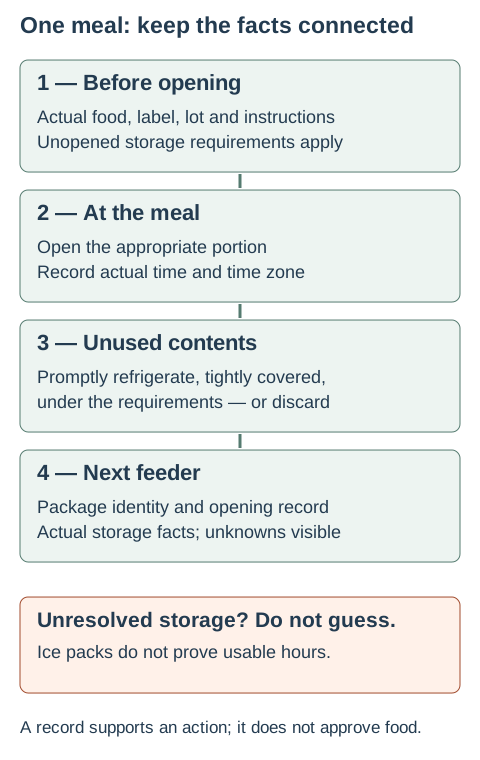
This original diagram follows one meal and its unused contents. It reminds you to make the storage decision promptly; it is not a tested cooler design or a food-safety calculator. Product identity and instructions stay with the food at every handoff.
View the full meal and storage map · Download the original map (SVG)
If travel disrupts a veterinarian-directed feeding or medication plan, arrange appropriate advice before departure. Do not solve storage by mixing in another food or changing a prescribed diet without that advice. An unfamiliar replacement creates a separate feeding question.
Practise six travel and storage decisions
These fictional cases test planning and interpretation. They do not describe tested coolers, actual pets, measured products or clinical outcomes. Read each explanation before applying a similar idea to an actual package.
Case 1
A hotel lists a mini-fridge. You plan to keep an opened can overnight, but its temperature and access have not been checked. Is the storage arrangement complete?
Show answer and explanation for case 1
No. Confirm the refrigerator and applicable instructions before relying on it.
FDA specifies a refrigerator at 40°F or below for unused or leftover canned and pouched food. An amenity name does not establish that condition. Confirm that the refrigerator is available when needed and suitable for the planned storage. If you cannot maintain the requirements, change the packing arrangement or discard unused food rather than assuming an overnight allowance.
Case 2
You carry intact, unopened portions of the pet’s familiar shelf-stable wet food. Their labels and storage requirements remain with them, and each portion will be opened at a meal. Does this reduce planned transport of opened leftovers?
Show answer and explanation for case 2
Yes, when the portions fit the existing feeding plan and unopened storage requirements are met.
Keeping food unopened until needed can remove a planned opened-leftover stage. It does not remove label, package-condition or temperature checks. Do not choose a new diet, another species’ food or extra portions for packaging convenience. Any unused contents after opening still need the prompt refrigeration-or-discard decision.
Case 3
An opened can is in a cooler with two ice packs. Nobody knows the temperature during a long stop. Can the ice-pack count prove the food remains suitable?
Show answer and explanation for case 3
No. The storage history is unresolved.
The cited sources do not provide a two-ice-pack rule, a cooler-duration table or a way to approve food from unknown temperature history. Do not feed it merely because it smells ordinary or feels cool. Keep uncertain food out of feeding, discard unused food when you cannot meet the requirements, and arrange appropriate familiar replacement food without overriding a veterinarian-directed diet.
Case 4
A caregiver notes that a can’s printed “best by” date is months away. It was opened during yesterday’s journey. Can the unopened date replace the opening record?
Show answer and explanation for case 4
No. Record the opening event separately.
Purina’s reviewed pages say the printed date applies to unopened packaging. Refrigerated opened-wet-food guidance is a separate instruction. Copy the actual opening time and time zone where relevant, the product identity and applicable instructions. A recent-looking label cannot reconstruct the opening event or cancel a storage problem.
Case 5
Purina’s cat page says bowl leftovers kept for more than an hour should be discarded. Its dog page says not to leave wet food in the bowl for more than a few hours. Can these establish a precise two-hour rule for every wet pet food?
Show answer and explanation for case 5
No. The wording, context and products differ.
The cat statement is explicit; the dog phrase is not an exact two-hour threshold. Neither establishes one rule for all brands, products or conditions. Use the actual food’s applicable instructions, and keep FDA’s prompt refrigeration-or-discard instruction separate from bowl timing. Do not turn a vague phrase into a precise deadline.
Case 6
An unopened pouch is swollen, and a pet became sick after eating that product. Should you continue it until the trip ends because the printed date has not passed?
Show answer and explanation for case 6
No. Stop feeding that product and call the veterinarian.
FDA lists swollen or leaking packages and a pet becoming sick after eating as potential product problems. For a related health problem, its guidance says to stop the product and call the veterinarian. Preserve the actual package and useful facts where practical, keep suspect contents inaccessible, and seek appropriate urgent veterinary help for urgent illness. A travel record cannot diagnose the cause or justify waiting.
Make the handover usable by the next feeder
Finish with a record another caregiver can use without asking you to reconstruct the journey. Keep unknown facts visibly unknown. When crossing time zones, record the time zone with the actual opening event so a clock change does not silently alter the apparent history.
WET-FOOD TRAVEL RECORD
Pet and existing feeding instructions:
Exact product / manufacturer / original package reference:
UPC / lot / printed date and its wording:
Unopened storage instruction and source:
After-opening instruction and source:
Bowl-leftover instruction and source:
Meal stop / opening date, time and time zone:
Unused contents: promptly refrigerated or discarded:
Storage location / actual temperature and time checked:
Earlier storage facts or unknown interval:
Next feeder / remaining action / unresolved concern:
Download the packing checklist, blank route record and six worked decisions (TXT). It does not calculate a safe date or clear a product for feeding. Update the actual package, opening event and handover when they change; do not keep an old “checked” note for a new portion.
If a pet has a health problem related to the food, FDA says to stop feeding that product and call the veterinarian. Preserve exact identifiers and useful storage facts where practical, keep suspect contents away from pets, and seek appropriate urgent care for urgent illness. Do not wait several meals or until the trip ends to see whether a record adjustment helps.
A useful plan ends with actual food, applicable instructions, the next storage location and a clear action for unused contents. For ordinary handling at home, read the leftover wet-food storage guide; for several packages and pets, keep the linked inventory.
Sources and further reading
- FDA: Proper Storage of Pet Food & TreatsOriginal identifiers, unopened-can storage, prompt refrigeration or discarding of leftovers, refrigerator temperature and product concerns.
- FDA: Tips for Safe Handling of Pet Food and TreatsPackage condition, handwashing, clean utensils, covered refrigeration and secure disposal.
- Purina: Dog Food Storage — How to Store Dog FoodManufacturer context: immediate covered refrigeration and use of opened wet food within three days. Bowl wording is “a few hours”, not a precise universal deadline.
- Purina: Cat Food Storage — How to Store Cat FoodManufacturer context: discard bowl leftovers after more than an hour; use covered refrigerated opened wet food within three days. Check the actual product instructions.