Practical guide
A Pet Food Inventory for Multiple Pets: Open Dates and Stock Rotation
Track one actual package at a time, preserve its original lot and date wording, and keep the intended pet, opening date and manufacturer instructions connected. Use the editable inventory and six worked cases to rotate appropriate stock without guessing shelf life or changing a pet’s diet.
Start with the actual packages, not a shopping list
A multi-pet food inventory answers three practical questions: which actual package is this, which pet may receive it, and what needs checking before it is used? It should connect the food on a shelf to its original label. A list saying “dog kibble, two bags” cannot distinguish two lots, two opening dates or two different feeding instructions.
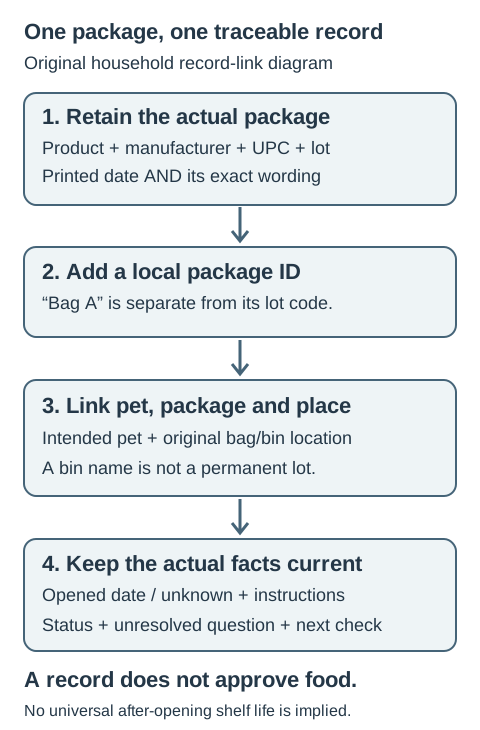
Give each bag, can or pouch you need to track a simple local package ID. The ID is a household reference, not a manufacturer lot code. Keep both. If you have several unopened identical cans, a group record can describe a genuinely matching lot and printed date, but separate an opened can and split the group when those facts differ. Record the actual quantity without implying every remaining unit has been inspected.
Assign the intended pet or compatible group from the current feeding instructions. Keep dog and cat foods, life-stage differences and veterinarian-directed diets identifiable. This guide organises stock; it does not select a food, determine nutritional suitability or change a prescribed diet. An inventory can reveal a question without answering the veterinary part of it.
Record the facts that survive a bin refill
Build the record while the original packaging is available. Copy the identifiers directly, and retain a clear label photo as a supplement to the package. Avoid abbreviating a lot code until it is indistinguishable from another. A local ID such as “Bag A” is useful only when you can point to the corresponding physical package.
Use the following fields in the downloadable text sheet or the editable inventory. Blank fields mean unrecorded, not checked and approved. The form uses free-text dates so you can preserve the package’s exact wording or write “unknown” without inventing a calendar date.
| Field | What to write | Why it matters |
|---|---|---|
| Local package ID | A short unique name for this actual bag, can or pouch. | Links the physical package, its record and any secondary container. |
| Intended pet or group | Which pet may receive this product under its current feeding instructions. | An older bag is not a reason to swap a pet’s prescribed or otherwise unsuitable food. |
| Exact product and identifiers | Product name/manufacturer, UPC and exact lot code; retain the original packaging. | Same-looking products and different lots must remain distinguishable. |
| Printed date and wording | Copy the date exactly, together with “best by”, “use by” or other wording. | The meaning and date format need the manufacturer’s explanation, not a guessed conversion. |
| Actual opening date | The known opening date; write unknown when it was not recorded. | Opening is a separate event. The printed date cannot reconstruct when a bag was opened. |
| Storage and after-opening instructions | Exact applicable label/manufacturer instructions and where you found them. | The inventory does not invent a universal number of days after opening. |
| Location and current status | Original bag/bin reference, storage location, open/unopened/on hold/finished/discarded. | A listed product is not automatically cleared for feeding. |
| Next check and responsibility | A specific uncertainty to resolve and the household person responsible. | A shared record prevents one person’s assumption becoming another person’s instruction. |
Keep the record where everyone who feeds the pets can find the current version. Record changes when they happen: opening a new bag, moving a package to a bin, finishing it or putting it on hold. A shopping reminder can link to this record, but it should not replace the package identity.
Keep the original package linked to its container
FDA recommends keeping pet food in its original container so the UPC, lot number, manufacturer or brand and “best by” date remain available. Its storage guidance prefers placing the entire original dry-food bag inside a secondary container. Fold the bag top tightly and follow the applicable storage instructions; the bin does not replace them.
If you pour dry food into a container, FDA says to use a clean, dry container with a snug-fitting lid and retain the package identifiers. Its example is cutting out and attaching the required packaging information, then updating it when the next bag is used. Record which package ID supplies that bin. Wash and dry the container between finishing one bag and refilling it; old crumbs and fats should not carry into the next refill.
Do not top up a half-full container from a different bag and then keep only the new label. That breaks the useful one-package-to-record connection: neither a bin name nor a scoop identifies which lot a portion came from. If mixing has already happened, record the known packages and the uncertainty. Do not label the mixture as one confirmed lot or claim the uncertainty has been solved by a new sticker.
Rotate only food that remains appropriate to use
“Use the oldest first” is incomplete. First identify products appropriate for the intended pet under its current instructions. Then check the actual package, relevant printed-date meaning, storage conditions and applicable after-opening requirements. Do not feed a damaged, suspect or unsuitable product merely because it is oldest.
For comparable open packages that still meet the applicable requirements, the recorded opening dates can help the household avoid forgetting the earlier one. Keep each lot identifiable. Where manufacturer instructions set a particular after-opening limit, record the instruction and the known opening date together. Do not use that limit for another product, another format or a package with an unknown opening date.
Unopened purchases also need their printed dates and condition checked. A recent purchase is not proof of a later printed date. Put the packages you intend to use next in an identifiable place and leave a clear note for other feeders. Rotation is an organisational decision within the actual instructions, not a food-safety calculation.
| Situation | Useful inventory action | What must not be inferred |
|---|---|---|
| Two matching, appropriate open bags | Keep separate IDs and lots; compare known opening dates after checking applicable instructions and condition. | That the earlier opening date overrides a product problem or printed-date concern. |
| An older food assigned to another pet | Keep it with that pet’s record and instructions. | That stock reduction permits a diet swap. |
| Unopened stock has differing printed dates | Copy exact wording and dates; check meaning with the manufacturer where uncertain. | That purchase order proves expiry order. |
| Opening date is unknown | Mark unknown and identify the applicable manufacturer guidance or question. | A guessed opening date derived from the printed date. |
| One package is suspect or on hold | Keep it out of the normal use-next sequence and record the reason. | That the inventory status diagnoses a problem or clears the product for feeding. |
Keep printed dates, opening dates and storage instructions separate
A printed date belongs to a particular package and wording. An opening date records a household event. Storage requirements describe conditions. Those three facts interact, but they are not interchangeable. Copy the whole printed-date phrase before interpreting a short number sequence; an unfamiliar format or code is a manufacturer question.
The two FDA pages cited here do not set one universal shelf life after opening for all pet foods. Do not fill that gap with a fixed rule such as “every dry food lasts six weeks” or “every opened can lasts three days.” Use the actual product label or the manufacturer’s applicable instructions. If those instructions are absent or unclear, record the gap rather than generating a plausible deadline.
FDA advises storing dry food and unopened canned food in a cool, dry place below 80°F. Its handling guidance says unused or leftover canned and pouched food should be promptly refrigerated or discarded, tightly covered when refrigerated, with the refrigerator at 40°F or below. These are source storage directions, not evidence that every product remains usable for a particular number of days. Follow any applicable product-specific requirements as well.
For a fuller explanation of the package fields, read pet food expiration dates and lot codes. This inventory guide concentrates on keeping multiple packages, pets and opening events connected; it does not replace that label-reading task.
Make handovers specific enough for another feeder
A useful handover says “Bag A is the current food for Pet A, inside Bin A; the original bag and lot remain with it,” followed by the relevant opening date and instructions. “Use what is in the blue bin” fails if someone refills the bin or changes the label. Bin colour identifies a location, not a permanent product.
Agree who records each opening and who checks uncertain manufacturer wording. Mark a finished record finished; begin a new record for a different package rather than overwriting the old lot. Keep recent records long enough to answer a genuine product or feeding-history question; this guide does not prescribe a universal retention period.
The editable tool below works in the current page and exports a plain-text copy you can keep or print. It does not upload your entries or automatically save them between visits. Save a copy before closing the page, and give other household feeders the current version. The tool does not calculate safe dates or approve stock from a status choice.
Open the editable package inventory, or download the blank text record in the downloads section. The date fields accept exact wording and unknown values. A new record starts blank; it is your responsibility to enter the actual package facts.
Downloads: Blank package records and six worked decisions (TXT) · Save the editable inventory for offline use (HTML).
Keep product problems out of ordinary stock rotation
FDA’s storage guidance lists potential pet-food problems including a foul odour, swollen or leaking cans or pouches, foreign objects and a pet becoming sick after eating the food. A normal-looking printed date does not cancel a concerning observation. Keep the suspect food away from feeding while you address the problem and preserve the actual packaging details where practical.
If your pet has a health problem related to pet food, FDA says to stop feeding that product and call your veterinarian. Do not keep feeding it for several meals to see whether an inventory adjustment helps. Urgent illness needs appropriate urgent veterinary help. A stock sheet is useful evidence, not a diagnosis or a reason to delay care.
Record the exact product, lot, date wording, when the concern was noticed, relevant storage facts and which pet had access. Follow appropriate manufacturer or official guidance for product questions and recalls. Do not substitute a recalled-product search with a guess that all bags from a familiar brand are equivalent. For old or spoiled food being discarded, FDA’s handling advice is to place it securely in a closed bag in a covered trash can so pets cannot get it.
Practise six package and handover decisions
These fictional cases test the record, not the quality of a real brand. Each explanation states what the available facts support and which uncertainty must remain visible.
Case 1
Two identical bags have different lots. Bag A was opened first; Bag B was opened later. Can one line saying “two bags” preserve the opening history?
Show answer and explanation for case 1
No. Give the two actual packages separate records.
Record each lot, exact printed date and opening date. If both remain appropriate under the applicable instructions and condition checks, the earlier recorded opening can inform stock rotation. That does not permit ignoring a concern with Bag A. Keep the physical bag and any bin linked to its own ID; merging the records removes information rather than simplifying the decision.
Case 2
A household has an older dog food and a newer veterinarian-directed food for a cat. Should the cat receive the older dog food so nothing is wasted?
Show answer and explanation for case 2
No. Rotation must stay within the intended pet’s applicable feeding instructions.
An older opening date does not make a product appropriate for another species or a prescribed diet. Keep the foods and assigned pets identifiable. A food-change or diet-suitability question belongs with the appropriate veterinarian, not with the inventory’s use-next order. The record can show surplus stock without authorising a substitution.
Case 3
An opened bag has a readable “best by” date, but nobody remembers opening it. Can you work backwards to estimate the opening date?
Show answer and explanation for case 3
No. Record the opening date as unknown.
The manufacturer’s printed date and the household’s opening event are different facts. Check applicable after-opening and storage instructions, retain the package and record the unresolved question. An exact-looking guessed date creates false confidence for the next feeder. Neither this guide nor the editable tool supplies a universal after-opening deadline.
Case 4
A bin still contains food from Bag A. Someone pours Bag B over it and tapes only Bag B’s lot to the lid. Is the contents’ lot now confirmed?
Show answer and explanation for case 4
No. The mixture is not established as one lot.
Record the known contributing packages and the uncertainty instead of relabelling all contents as Bag B. For future refills, preserve the original package connection and follow FDA’s clean-and-dry-between-bags guidance. A new sticker changes a label, not the provenance of food already in the container. Do not claim that a local bin ID resolves the mixed-lot uncertainty.
Case 5
An opened pouch is promptly refrigerated, but the inventory has no manufacturer instruction for how long it may be kept after opening. Does “refrigerated” create a three-day allowance?
Show answer and explanation for case 5
No. Record and resolve the missing product-specific instruction.
FDA’s cited guidance supports prompt refrigeration or discarding and the stated refrigerator temperature, but it does not give one three-day rule for all pet foods. Record the actual opening event, storage conditions and applicable instructions. Do not transfer another product’s limit to this pouch. If condition or a health concern makes the product suspect, address that issue rather than calculating a rotation date.
Case 6
The printed date has not passed, but a pouch is swollen and a pet became sick after eating that product. Should the household keep feeding it until the stock review?
Show answer and explanation for case 6
No. Stop feeding the product and call the veterinarian about the related health problem.
FDA identifies swollen or leaking packaging and illness after eating as possible product problems. The printed date does not clear them. Keep other feeders from using the suspect food, preserve the lot and relevant facts where practical, and seek appropriate urgent veterinary help for urgent illness. The stock record supports an accurate handover; it cannot diagnose the cause or justify waiting several meals.
Finish one useful inventory pass
Start with the foods currently open and the packages likely to be used next. Match each record to a physical package, assign the intended pet, copy the lot and printed wording, and record the actual opening date or unknown. Add the applicable instructions and location. Deal with suspect products and unresolved identity before treating a package as the next one to feed.
Then make the record usable by someone else. Test whether another feeder can identify the package and its original lot without relying on your memory. Update the record at the next opening or refill and save the new version. These small, accurate updates make the inventory useful; a large spreadsheet full of guessed dates does not.
Nutritional labels are separate reading tasks. The site’s guaranteed-analysis guide explains what its rows can and cannot establish, and the AAFCO-statement guide addresses adequacy wording. Neither substitutes for package identity, storage instructions or a veterinary diet decision.
Sources and further reading
- FDA: Proper Storage of Pet Food & TreatsOriginal packaging and identifiers, secondary containers, cleaning between bags, storage directions and action for product-related health problems.
- FDA: Tips for Safe Handling of Pet Food and TreatsPackage condition, handling and storage directions, prompt refrigeration or discarding of wet-food leftovers, and secure disposal of old or spoiled food.