How to Read an AAFCO Statement on a Pet Food Label
Read the nutritional adequacy statement for the exact food, usually in small print on the back or side. Mark the product, species, life stage, qualifications and stated basis. AAFCO does not approve or endorse individual pet foods.
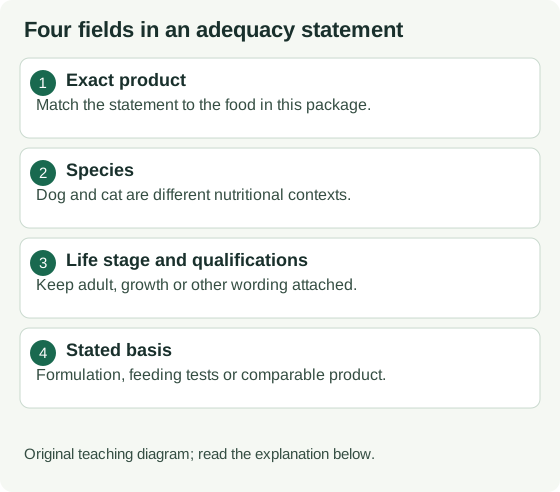
Find the nutritional adequacy statement
Look in the small print on the back or side of the package for the nutritional adequacy statement. AAFCO identifies it as the field that connects the food with the intended pet and life stage. Read the full line and any attached qualifications rather than only a large front-panel claim.
The product named in the statement should match the exact food. A company may sell different recipes with different statements; a familiar brand name does not establish the status of every product. Keep a clear photograph of the actual line with the product identity.
Mark the fields that change the interpretation
| Field to mark | Question answered | Reading mistake to avoid |
|---|---|---|
| Product | Which exact food does this line describe? | Applying a different recipe’s statement to this bag. |
| Species | Is the statement for dogs or cats? | Using an animal picture instead of the stated species. |
| Life stage and any qualification | For what stage and stated context is adequacy claimed? | Dropping a limitation because the front panel says all ages. |
| Stated basis | Does it refer to formulation, feeding tests or a comparable tested product? | Treating every reference to tests as a direct test of this food. |
These fields serve different purposes. A calorie statement is not a substitute for the adequacy line, and a high protein minimum cannot establish that a product is a complete diet for the species and stage.
Read the evidence wording without turning it into a ranking
Wording about being formulated to meet nutrient profiles refers to the formulation basis. Wording about animal feeding tests refers to the feeding-test basis described in the statement. A comparable-product statement connects the food to a tested product; it does not automatically mean this exact food was directly fed in that test.
The detailed companion guide compares those evidence routes with six worked label-reading cases. Here the task is simpler: preserve which basis the actual line names, together with the product, species, life stage and qualification. Do not infer a universal product-quality ranking from the basis alone.
AAFCO does not approve individual pet foods
AAFCO’s consumer FAQ states that it does not approve, certify or endorse pet foods. There is no individual AAFCO-approved pet food list maintained by AAFCO. The reference in a nutritional adequacy statement concerns its standards or procedures, not an approval badge for the brand.
If an advertisement uses an approval claim, keep the exact wording and compare it with the package’s actual adequacy statement. A logo, seal or retailer description is not a substitute for that line. Check the manufacturer’s explanation when the claim and statement do not agree.
Recognize a different nutritional role
A line identifying intermittent or supplemental feeding does not make the product an ordinary complete sole diet. Treats and snacks can also be labeled according to their intended role, and may not carry the same adequacy statement as a complete food. Read the actual designation rather than assuming that anything sold in a pet-food aisle replaces meals.
Some veterinary medical foods have a supplemental or intermittent statement because their clinical formulation serves a specific purpose. That is a veterinary-plan context, not a reason to use an ordinary supplemental product as the main diet at home. Keep the relevant instructions with the statement and ask the veterinary team how the food is intended to be used.
Leave with one accurate statement record
An adequate record identifies the actual product, species, life stage, any limitation, stated basis and nutritional role. Save what the statement says without upgrading it to approval, proof of superiority or a recommendation for an individual pet.
If the line is missing, unreadable or inconsistent with another claim, ask the manufacturer for the current exact product’s information. For a pet with a medical condition, growth concern or prescribed diet, take that information to the veterinary team rather than letting a short label fragment choose the care plan.
Save a usable record
Download the plain-text record, or copy the fields below. Keep unknown facts marked unknown.
NUTRITIONAL ADEQUACY STATEMENT RECORD
Exact product and package:
Full statement or readable photo:
Species:
Life stage:
Qualification or limitation:
Stated basis (formulation / feeding test / comparable product):
Complete-diet or supplemental role:
Manufacturer claim that needs clarification:
Existing veterinary instruction or question:
Check your understanding
A food mentions AAFCO. Is that an approval of the brand?
No. AAFCO states that it does not approve, certify or endorse pet foods. Read the actual nutritional adequacy statement and its scope.
Does a comparable-product statement prove this exact recipe had a direct feeding trial?
It identifies comparison with a tested product. It does not automatically establish a direct test of the food in this package. Preserve the basis instead of changing its meaning.
Can the calorie statement establish nutritional adequacy?
It describes energy in food weight or a familiar unit. Species, life stage and complete-versus-supplemental role require their own adequacy or designation information.
What should I do when the line is incomplete in a retailer photo?
Obtain the current package line or matching manufacturer information. Keep the exact product and missing fields visible; do not infer the statement from a different recipe.
Sources and scope
These sources explain US dog and cat labels and pet-food handling. The examples, diagrams and worksheets are teaching material rather than measurements of real products. Follow the actual product’s instructions and your veterinary plan where one applies.