Wet and Dry Dog Food for Everyday Feeding: A Measured Meal Record
For everyday mixed feeding, record each food’s actual amount and matching calories separately, then add known extras. Start with an existing feeding plan. A can added to an unchanged dry-food amount adds calories, and unused wet food still needs prompt handling.
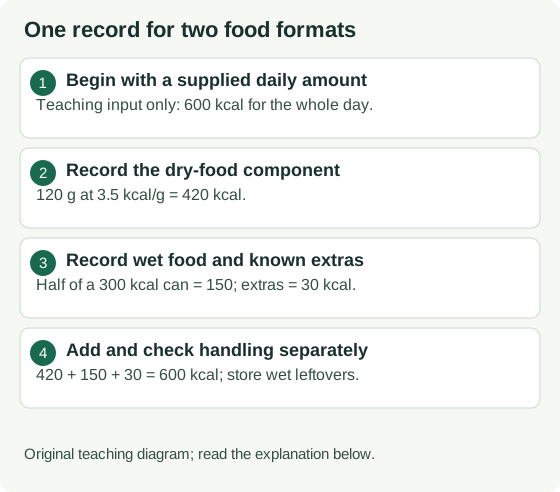
Decide what the everyday record needs to answer
Wet food, dry food and a mixture can each fit an appropriate feeding plan. The format alone does not establish whether the product is a complete diet for the dog’s life stage. Read the exact species and nutritional adequacy statement for each food, and check a therapeutic plan with the veterinary team before adding another product.
This page records the amounts and handling of a mixed-format day. If you are still comparing shopping cost, label protein or format tradeoffs, use the broader wet-versus-dry comparison guide. A daily record starts with the actual products and an existing amount or calorie plan rather than choosing a universal winning format.
Put both calorie statements on the same note
Copy the dry food’s kcal/kg and any matching cup definition. For wet food, copy its kcal/kg or the calories in the exact whole can or pouch. Do not assume a cup of kibble and a cup of wet food contain equal calories.
For a weighed component, multiply its grams by its own kcal/g. For a whole-container fraction, multiply that fraction by its matching whole-container calories. Keep each product on a separate line until both are in kcal. Water added to food does not create extra food calories, but an added topper does need its own quantity and calorie information.
Work through one hypothetical mixed-format day
| Component | Matching input | Calculated energy |
|---|---|---|
| Dry food: 120 g | 3,500 kcal/kg, or 3.5 kcal/g | 120 × 3.5 = 420 kcal |
| Wet food: half a can | 300 kcal per this whole can | 0.5 × 300 = 150 kcal |
| Known extras | An already recorded total | 30 kcal |
| Entire day | Add the three known entries | 420 + 150 + 30 = 600 kcal |
The foods and 600-kcal amount are invented teaching inputs. They show how to record a combination within a supplied total; they do not set intake for a real dog or establish that a particular mixture meets its nutritional needs. Whether and how to combine foods belongs within the appropriate feeding plan.
If a caregiver adds the other half-can while leaving dry food and extras unchanged, the arithmetic becomes 420 + 300 + 30 = 750 kcal. The additional half-can increases the day by 150 kcal. Calling it a topper does not remove it from the total.
Split the supplied amounts rather than adding another allowance
For two equal meals using the fictional day, each meal could record 60 g of dry food and one quarter of the same whole can. The 30 kcal of extras remains a day-level entry. Do not put another 30 kcal into each meal unless the existing plan actually calls for it.
An amount labeled per day must be split across the day. An amount labeled per meal already refers to each meal. Keep that distinction visible for the next feeder. If a prescribed plan uses different morning and evening amounts, copy those exact entries rather than forcing an equal split.
Plan the unused wet food before serving
The unused half of the example can has a storage task even though its calories are already understood. FDA advises promptly refrigerating unused or leftover canned and pouched pet food, tightly covered, or discarding it; the refrigerator should be 40°F or below. Follow the actual product’s after-opening and bowl-leftover instructions.
Food still in the can and food left in the dog’s bowl may have different handling instructions. Save the actual product identity, lot, printed date wording and known opening event. Do not infer an after-opening day allowance from the unopened date, or leave food on the counter while finishing a calorie journal.
Dry food and unopened canned food need a cool, dry storage location; FDA specifies below 80°F. A product sold refrigerated or frozen has its own requirements from the start. “Unopened” does not turn every food format into a shelf-stable product.
Leave a repeatable note for another feeder
- Exact product names and the current label statements.
- Amount of each component per meal, with its unit and daily total clearly labeled.
- Any treat or topper amount already included, and who records additional items.
- Location and identity of the unused wet food, known opening event and applicable storage instruction.
- Amount offered, separately measurable leftovers and any uncertainty about what was eaten.
A record should prevent double feeding and make a real discrepancy easy to spot. It is not permission to keep adjusting a dog’s meals for several days when appetite, health or unexpected weight changes need veterinary attention. If there is a product-related health problem, FDA advises stopping that product and calling your veterinarian.
Save a usable record
Download the plain-text record, or copy the fields below. Keep unknown facts marked unknown.
EVERYDAY WET + DRY FEEDING RECORD
Existing plan and source:
Daily versus per-meal amount:
Dry product, kcal/kg, grams offered:
Wet product, exact container size, kcal and amount offered:
Known treats or toppers already included:
Calculated meal and day totals:
Food eaten, leftovers or unknown access:
Unused wet-food location and known opening event:
Actual storage instruction:
Next feeder and completed meal note:
Check your understanding
In the example, what happens if another half-can is added without removing anything?
The day rises from 600 to 750 kcal. The added half of the same 300-kcal can contributes 150 kcal. This identifies the arithmetic change, not what should be fed.
Does equal energy prove two combinations are nutritionally interchangeable?
No. Nutritional role, species, life stage and clinical instructions still matter. Equal calories do not establish equal nutrient balance or suitability.
Can I use dry-food kcal/g for the wet component?
Use each product’s own matching calorie statement. The foods include different amounts of water and can have different energy densities.
Is the remaining half-can cleared for storage because the math is correct?
No. Promptly refrigerate it under the applicable requirements, tightly covered, or discard. Keep its identity and opening record; handle bowl leftovers separately under actual instructions.
Sources and scope
- AAFCO: Calories
- AAFCO: Reading Labels
- FDA: Complete and Balanced Pet Food
- FDA: Proper Storage of Pet Food and Treats
- FDA: Safe Handling of Pet Food and Treats
These sources explain US dog and cat labels and pet-food handling. The examples, diagrams and worksheets are teaching material rather than measurements of real products. Follow the actual product’s instructions and your veterinary plan where one applies.