Pet Food Calorie Math: Count Meals, Treats and Toppers
Convert every known food amount into its own calories, then add each entry once. Include meals and extras, and distinguish food offered from food eaten. The total describes the record; it does not set a pet’s daily calorie needs.
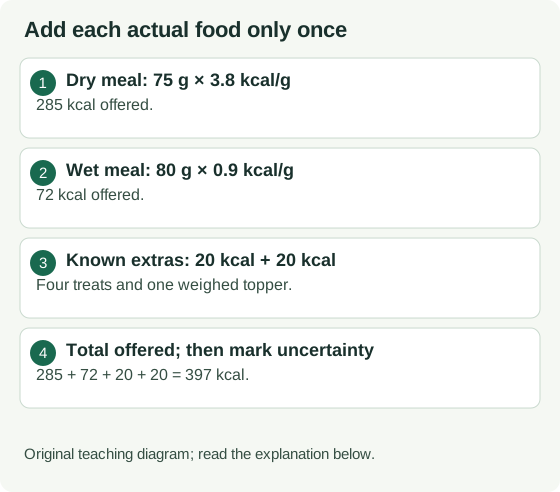
Define the day and list every food source
Choose a clear period, such as breakfast through the end of that same day, and use one shared record. Include meals, treats, chews with known calorie information, toppers, table food and food another person gives. The aim is to describe the current intake, not to invent a weight-loss target.
Record each exact product and quantity before totaling it. A name such as “one snack” is insufficient if nobody knows its size or calories. Keep an unresolved entry in the record instead of dropping it because a calculator needs a number. This makes the known total useful without presenting it as complete.
Convert each line to calories using its matching unit
For grams of food, divide its as-fed kcal/kg by 1,000, then multiply by grams. For a count of identical treats, multiply the number by the matching kcal per treat. A fraction of a can needs that exact whole-container calorie amount.
Do not combine grams of several foods before multiplying by one density. Do not count a topper once as part of a weighed food mixture and again as a separate additional entry. If you weigh the foods separately as they are added, their separate gram entries give a clearer calculation.
Add a complete hypothetical record
| Item | Given information | Energy offered |
|---|---|---|
| Dry meal: 75 g | 3,800 kcal/kg = 3.8 kcal/g | 75 × 3.8 = 285 kcal |
| Wet meal: 80 g | 900 kcal/kg = 0.9 kcal/g | 80 × 0.9 = 72 kcal |
| Four treats | 5 kcal per matching treat | 4 × 5 = 20 kcal |
| Topper: 10 g | 2,000 kcal/kg = 2 kcal/g | 10 × 2 = 20 kcal |
| Known day total | Four separate entries | 285 + 72 + 20 + 20 = 397 kcal |
These foods and amounts are fictional arithmetic inputs. They do not prescribe a day’s food for a dog or cat or approve these products as a diet. If the feeding plan already includes treats or a topper, record them within that plan rather than assuming the main-food amount automatically permits unlimited extras.
Separate offered calories from estimated calories eaten
The table gives 397 kcal offered. Suppose 5 g of that same dry food is separately known to remain uneaten, with no mixing or spill. Its energy is 5 × 3.8 = 19 kcal; the estimated known intake becomes 397 − 19 = 378 kcal.
That subtraction is not defensible if the remainder contains wet food, added water or an unknown mix. Nor does an empty bowl prove which pet ate it in a shared household. In these situations record the offered total and describe what is unknown about intake. Do not make an uncertain total appear precise by reporting more decimal places.
Find a practical discrepancy without setting a new target
If another caregiver supplies six additional matching 5-kcal treats, the known offered total increases by 30 kcal to 427 kcal. A day log makes that addition visible. It does not tell you to remove 30 kcal from a prescribed diet or decide that the existing allowance is excessive.
If someone took training treats from the day’s already measured kibble portion, mark that transfer so it is not counted a second time. If training treats came from an extra scoop outside that portion, they are an additional entry. The origin of the food matters as much as its name.
Bring the known total and missing facts to the right discussion
Compare the record with an existing feeding plan, or use it to prepare a veterinarian question about weight, appetite or routine intake. AAFCO notes that individual calorie needs depend on factors such as age, weight and activity. The sum of a day’s food does not establish the pet’s appropriate energy requirement.
Ask the veterinary team for any intended changes and follow-up instructions when a weight-management or therapeutic plan is involved. Do not delay a sick pet’s care while waiting to finish a week-long journal. A known partial total plus an honest account of missing quantities is more useful than a complete-looking number built from guesses.
Save a usable record
Download the plain-text record, or copy the fields below. Keep unknown facts marked unknown.
ONE-DAY PET-FOOD CALORIE RECORD
Pet and date / start and end of record:
Existing feeding plan, if applicable:
Product | food amount | matching kcal unit | calculated kcal:
Meal 1:
Meal 2:
Other meals:
Treats, chews, toppers and table food:
Food moved from an already counted portion (avoid double count):
Known total offered:
Separately measurable uneaten food:
Estimated known intake, with limitations:
Unrecorded quantities, shared access or other uncertainty:
Question for the veterinary team:
Check your understanding
What does an extra 10 g of the example dry food add?
At 3.8 kcal/g it adds 38 kcal. Record it as extra only if it was not already included in the measured meal amount.
Why does the example intake become 378 kcal after a 5 g dry-food remainder?
The separately known dry remainder represents 5 × 3.8 = 19 kcal, so 397 − 19 = 378 kcal. This relies on a measurable remainder of that same food.
Can I subtract 5 g of unclear mixed leftovers using dry-food density?
No. The component amounts are unknown. Keep the offered total and explain the uncertainty rather than assigning the entire mixture the dry food’s density.
Do unrecorded snacks count as zero because they cannot be calculated?
No. Mark the food and missing quantity or calorie information. A known subtotal is useful, but it must not be called the complete daily intake.
Sources and scope
These sources explain US dog and cat labels and pet-food handling. The examples, diagrams and worksheets are teaching material rather than measurements of real products. Follow the actual product’s instructions and your veterinary plan where one applies.