Pet Food Life Stages: Adult, Growth and All Life Stages
Read the life stage in the actual nutritional adequacy statement, together with species and any qualification. Adult maintenance, growth, gestation/lactation and all life stages are different contexts; a front-panel age or size term does not replace that line.
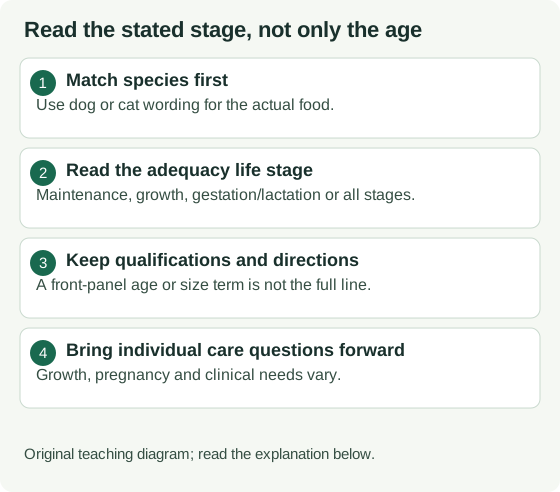
What life-stage wording tells you
AAFCO’s consumer guidance lists maintenance, growth, gestation/lactation and all life stages. Growth includes puppies and kittens; gestation/lactation concerns pregnancy and nursing. Different stages can require different amounts and ratios of nutrients and different feeding rates.
FDA describes two broad nutrient-profile groups for dogs and cats: growth and reproduction, and adult maintenance. Those profile groups and the fuller list of life-stage wording describe related but different parts of the label system. Do not count them as competing age lists. Read the claim actually attached to the food.
Compare the stated context without choosing a food by age alone
| Wording to identify | Context to retain | Question left open |
|---|---|---|
| Adult maintenance | The stated adult species context | The amount and suitability for this individual pet. |
| Growth | The stated growing-animal context and qualifications | The appropriate product and feeding plan for this puppy or kitten. |
| Gestation/lactation | Pregnancy and nursing context | The individual veterinary and feeding instructions. |
| All life stages | The full claim, species and attached qualifications | Which directions and amounts apply to this pet now. |
The table explains labels; it does not recommend an amount or product for the situations listed. Read species first. An all-stage claim for dogs cannot serve as the adequacy statement for cats.
Why fitting a weight row is insufficient
A puppy or kitten may weigh the same as an adult animal and still have a different nutritional context. An adult feeding chart and adult adequacy statement do not establish growth suitability simply because the current weight appears in the table.
Likewise, the amount used for a sedentary adult pet cannot be silently applied to a growing, pregnant, nursing or working animal. AAFCO’s selection guidance explains that life stage and condition affect nutritional needs. Use the applicable product directions and obtain individual veterinary guidance for the relevant situation.
All life stages does not mean one serving instruction
AAFCO notes that an all-life-stage product should have different feeding directions for growth, gestation/lactation and maintenance. Read the correct part of the directions after reading the adequacy claim. Do not pick one visible amount and assume it applies equally across all stages.
Keep any qualification or growth restriction with the full statement. A short retailer description may omit that detail. If the current package and website wording differ, preserve both sources and ask the manufacturer for the information applicable to the exact food.
An all-stage food is not automatically the best choice for every adult pet. Food energy, condition, activity, clinical context and the actual plan still matter. The wording establishes the scope claimed for the food, not a universal ranking.
How to read senior, size and lifestyle terms
Words such as senior, small breed, indoor or active can describe the intended market or product features. By themselves they do not supply the complete nutritional adequacy line or identify all its qualifications. Look for the actual species and recognized life-stage wording instead of treating the front-panel phrase as a substitute.
For an older pet, the word senior alone cannot decide whether a diet suits current body condition or a medical diagnosis. Preserve the actual adequacy and calorie information and ask the veterinary team what matters for that individual. The same principle applies to a size term on a growing dog’s package.
Make the next question specific
A useful note says which stage is claimed, which stage applies to the pet, what qualification or direction is unclear, and whether there is an existing veterinary plan. It does not have to guess the date for switching every puppy or kitten to adult food.
Ask the manufacturer to explain unclear current wording or directions. Ask the veterinary team about the individual food choice, amount, transition and monitoring when growth, reproduction or a clinical situation is involved. Keep those questions separate from the basic task of copying and interpreting the label.
Save a usable record
Download the plain-text record, or copy the fields below. Keep unknown facts marked unknown.
PET-FOOD LIFE-STAGE RECORD
Exact current product:
Species:
Full nutritional adequacy life-stage wording:
Qualification or restriction:
Applicable direction heading:
Front-panel age, size or lifestyle wording (separate):
Current pet stage and existing plan:
Manufacturer wording question:
Individual food, amount or transition question for the vet:
Check your understanding
A kitten fits the weight row on an adult chart. Does that make the chart appropriate?
Weight alone does not establish the nutritional or feeding context. Read the actual growth statement and applicable directions, and obtain the individual plan where needed.
Does all life stages mean the same amount for every stage?
No. AAFCO describes different directions for growth, gestation/lactation and maintenance. Select the applicable instructions rather than repeating one amount across every stage.
What does a senior word on the front panel fail to tell me?
It does not by itself provide the full species, adequacy stage, qualification or individual clinical suitability. Read the actual statement and keep the care question separate.
Why retain an attached qualification in a short record?
It can change the scope of the claim. Dropping it can make the recorded meaning broader than the actual label. Preserve the full line and ask for clarification if needed.
Sources and scope
These sources explain US dog and cat labels and pet-food handling. The examples, diagrams and worksheets are teaching material rather than measurements of real products. Follow the actual product’s instructions and your veterinary plan where one applies.