Complete and Balanced Pet Food: Main Diets, Treats and Toppers
Complete and balanced concerns required nutrients and their balance for the stated species and life stage. Read the adequacy statement to identify the food’s role. Treats, toppers and supplemental products are not automatically suitable as an ordinary sole diet.
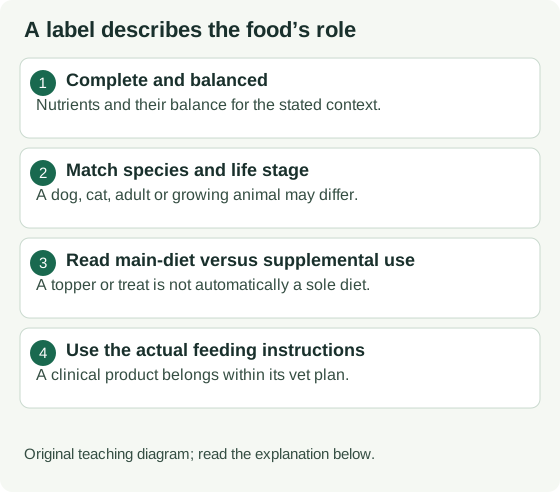
What complete and balanced means
AAFCO explains complete as containing the required nutrients and balanced as having them in the appropriate ratios. The claim is made in a stated species and life-stage context. FDA explains that a complete-and-balanced adequacy statement identifies a food intended to serve as the pet’s sole diet in that context.
The phrase does not mean every dog and cat should eat that product, or that every quantity is appropriate. Read the exact species and stage, the basis of the statement and the feeding directions. A food’s nutritional role and the amount an individual pet needs are separate questions.
Separate the ordinary roles on the shelf
| Product role | What to check | What not to assume |
|---|---|---|
| Complete diet for the stated context | Exact adequacy statement, species, life stage and directions | Suitable for every pet, stage or medical condition. |
| Treat or snack | Its stated role and any nutrition information | Replaces a complete main diet just because the pet likes it. |
| Topper or supplemental product | Actual designation and intended use | Adds a missing nutrient or becomes a complete diet when mixed casually. |
| Veterinary medical food | Actual adequacy statement and veterinary use instructions | Should be started or altered from an ordinary label-reading guide. |
A product called a treat may have additional adequacy information, so read what the actual package says rather than deciding from one everyday nickname. Equally, the word food in a product name does not automatically establish sole-diet adequacy.
Use dog and cat context explicitly
For a dog, a complete-and-balanced adult dog food statement concerns that species and adult context. It does not establish growth adequacy for a puppy. A statement for cats belongs to a different species context; dog and cat nutritional requirements are not interchangeable.
For a cat, a supplemental can sold for cats can still lack the nutritional role of a complete main diet. A cat image, fish ingredient or enthusiastic appetite does not change the designation. Read the complete line and its role before treating the product as a meal replacement.
These are interpretation examples, not product selections. AAFCO’s selection guidance emphasizes species, life stage and condition; an individual clinical situation needs the veterinary team.
Why adding food is more than a calorie calculation
Meals made mainly from a suitable complete diet and meals built largely from supplemental products are different nutritional arrangements. A treat or topper contributes to the feeding record, but calories alone do not establish that its nutrient balance can replace the same energy from the main diet.
Do not assume that a supplement is needed simply because it is sold beside a complete diet. Nor does adding an ingredient automatically improve a complete food. Keep the actual products and amounts within the established plan, and ask the veterinary team about intended additions when nutrition or a clinical goal is involved.
The daily-calorie guide can show what is being added. It cannot certify that a homemade combination, several toppers or two medical foods meet an individual pet’s needs.
Read veterinary product directions in their clinical context
AAFCO notes that some veterinary medical foods may use an intermittent or supplemental statement because particular nutrient factors are adjusted for disease management. This is an exception that needs the veterinarian’s intended use and monitoring plan. It is not an invitation to substitute an ordinary supplemental food for a complete diet.
If instructions say use as directed by your veterinarian, keep that instruction attached to the actual product. Obtain clarification before adding another food, replacing the product or changing the amount. The label’s role must be interpreted alongside the clinical plan rather than used to override it.
Make a main-diet role record
Write the exact product, species, life stage, complete or supplemental designation and applicable feeding instruction. Then list the other foods given and whether they belong within the existing plan. This is enough to identify a missing role question without turning the page into a brand ranking.
If the product’s claim is unclear, ask the manufacturer for the current statement. If the pet’s health or intended diet changes, bring the statement and feeding record to the veterinary team. AAFCO does not approve individual foods, and a complete-and-balanced phrase is not a universal guarantee of individual suitability.
Save a usable record
Download the plain-text record, or copy the fields below. Keep unknown facts marked unknown.
PET-FOOD MAIN-DIET ROLE NOTE
Exact current product:
Species and life stage:
Complete-and-balanced statement or supplemental designation:
Any attached limitation:
Applicable feeding instruction:
Role in the current plan:
Other treats, toppers or foods and their amounts:
Clinical instructions, if any:
Manufacturer or veterinary question:
Check your understanding
Does complete adult dog food automatically cover a growing puppy?
The adult statement alone does not establish growth adequacy. Read the actual growth or life-stage statement and follow the appropriate individual feeding plan.
Can a cat-labeled supplemental can be the main diet just because the cat eats it well?
Appetite and species imagery do not change its nutritional role. Read the actual designation and obtain the appropriate complete-diet or veterinary plan.
Do equal calories make a treat and a main-diet portion equivalent?
They can contribute equal energy while having different nutritional roles and nutrient balance. A calorie conversion cannot establish diet equivalence.
Why can some veterinary foods have a supplemental statement?
AAFCO describes clinical products with adjusted nutritional factors that may carry this statement. Their use needs the veterinarian’s purpose and instructions; the exception does not approve ordinary supplemental products as sole diets.
Sources and scope
- AAFCO: Reading Labels
- AAFCO: Selecting the Right Pet Food
- AAFCO: Frequently Asked Questions
- FDA: Complete and Balanced Pet Food
These sources explain US dog and cat labels and pet-food handling. The examples, diagrams and worksheets are teaching material rather than measurements of real products. Follow the actual product’s instructions and your veterinary plan where one applies.